

America's Team, Nobody's Champions: The Business Model Behind the World's Most Profitable Sports Franchise
FRONT ROW FILES: The business of sports & entertainment – behind the headline | Issue #005

THIS WEEK
Today’s topic came from a very unscientific place. Last year I watched America’s Sweethearts: Dallas Cowboys Cheerleaders on Netflix, which if you haven’t seen it is genuinely entertaining and has nothing to do with football. As an athlete myself I have a lot of respect for what those women do – watching the show you realize how demanding the side job of a cheerleader actually is, with daily training and rehearsals on top of everything else, while as a viewer on game day you only ever see the few minutes they spend on the sidelines and think it can’t be that hard. It’s one of those things that looks effortless precisely because of how much work goes into it.
Somewhere in the middle of watching it I started thinking about how strange it is that the Cowboys are everywhere – in marketing, in merchandising, in cultural conversation – but almost never show up when it actually matters on the field. I don’t follow the NFL closely. I look at the big results, but even from that distance it’s hard to miss that the Cowboys rarely feature at playoff time.
So I started pulling on that thread: how does a team that hasn’t won a Super Bowl in thirty years remain the most profitable sports franchise on the planet – more profitable than any European football club, any NBA team, anyone? The answer turns out to be less about football than about what Jerry Jones built around it. That’s the deep dive.
Happy Easter to those celebrating – enjoy the long weekend.
THE DEEP DIVE
$13 Billion, Zero Super Bowls Since 1995: How the Dallas Cowboys Became the Most Profitable Sports Franchise on Earth
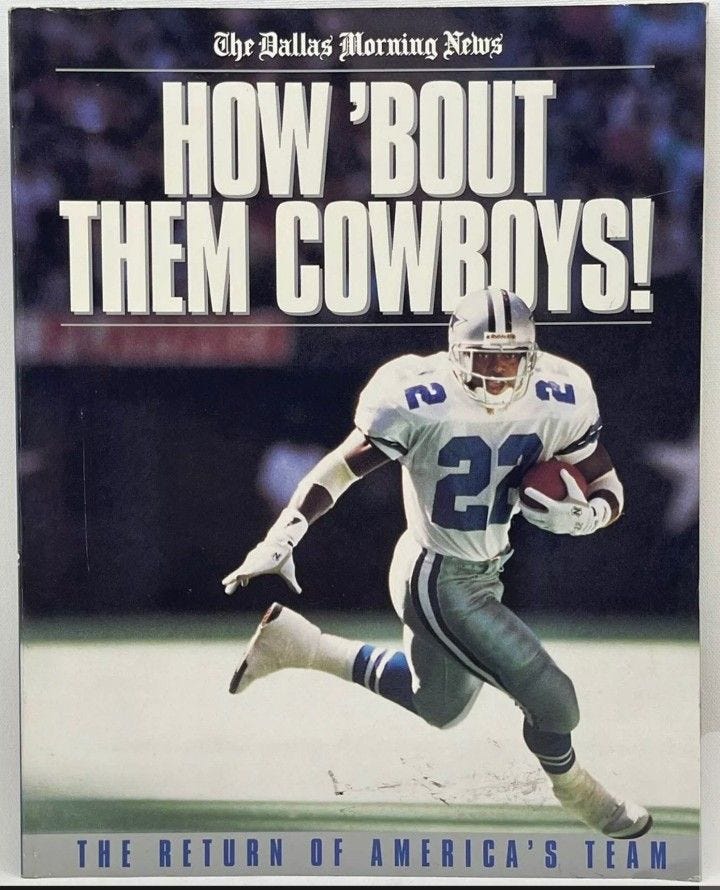
The Dallas Cowboys have not won a Super Bowl since January 1996. They haven’t played in an NFC Championship game since that same season. In 2025 they finished 7-9-1 and missed the playoffs for the second straight year. None of that has stopped them from being the most valuable and most profitable sports franchise on the planet for ten consecutive year – valued at $13 billion by Forbes and generating $629 million in operating income last season, more than double any other team in any sport outside of basketball’s Golden State Warriors. The question worth asking is why winning on the field barely matters to the business.
What happened
Jerry Jones is an oil and gas entrepreneur from Arkansas who bought the Dallas Cowboys in 1989 for $150 million, including the stadium and unfunded liabilities. The team was losing $1 million a month when he acquired it, the government had already foreclosed on 13% of the franchise, and Donald Trump had passed on buying it five years earlier, publicly calling it “a no-win situation.” Jones borrowed every dollar he could to complete the deal.
Within three years the Cowboys were winning Super Bowls – three titles in four seasons between 1992 and 1995, built around quarterback Troy Aikman, running back Emmitt Smith, and wide receiver Michael Irvin, known as “The Triplets.” The on-field success gave Jones the platform he needed, but what he built around it is the story that matters for this newsletter.
In 1995, Jones announced independent sponsorship deals with Nike, Pepsi, and American Express at Texas Stadium – the Cowboys’ then-home – targeting the direct competitors of Coca-Cola, Visa, and Reebok, all of which had league-wide deals with the NFL. The league sued him. Jones countersued. A year later both sides dropped their lawsuits, and the Cowboys kept their deals. That confrontation established a precedent that Jones has built an empire on: while the NFL distributes national TV and league sponsorship money equally across all 32 franchises, individual stadiums and their commercial operations belong entirely to the team that owns or operates them.
In 2009, Jones opened AT&T Stadium in Arlington – a billion-dollar venue with a capacity of up to 105,000, the largest jumbotron in sports history, and operating rights that remain entirely with the Cowboys. AT&T pays approximately $17-20 million annually for naming rights, and that money stays with Jones. In 2016, he opened The Star – a 91-acre, $1.5 billion mixed-use development in Frisco built around the Cowboys’ headquarters and practice facility, which includes a hotel, a fitness center chain, retail, office space, a members club, and an entertainment district. In 2008, he co-founded Legends Hospitality with the New York Yankees to manage concessions and merchandise at their venues – a company that now serves hundreds of clients across every major sports league globally. And unlike virtually every other NFL franchise, the Cowboys handle their own merchandise operation rather than outsourcing it to the league.
Naming rights: A sponsorship arrangement where a company pays for the right to have its name attached to a stadium, arena, or venue. The fee goes directly to the team or owner that controls the venue, not to the league, making it one of the most valuable forms of local commercial revenue in professional sports.
Legends Hospitality: A sports and entertainment services company that manages the commercial operations inside venues – concessions, merchandise, ticketing, and premium hospitality – on behalf of teams and stadiums. Rather than outsourcing these functions to third parties, Jones brought them in-house through Legends, meaning the Cowboys capture the profit margin on food, drink, and merchandise sales that most franchises give away to outside operators.
The numbers
The Cowboys generated $1.27 billion in revenue in 2024 – the highest of any NFL team and the highest of any sports franchise in the world outside of Real Madrid’s $1.4 billion. Here is how that breaks down against the rest of the league:
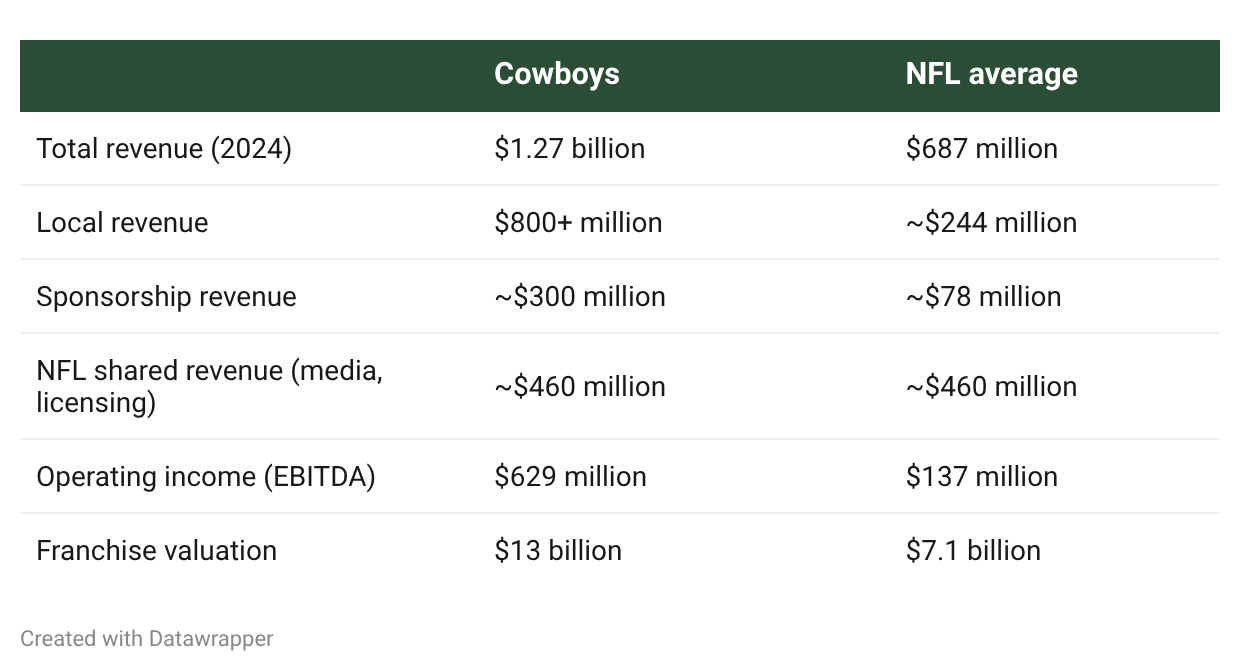
The most important line in that table is local revenue. Every NFL team receives the same league distribution – approximately $460 million last season from national TV deals, licensing, and shared sponsorships. The Cowboys are the only team in the NFL for which that $460 million check does not account for more than half of total revenue. Their local revenue – sponsorships, stadium events, merchandise, real estate – tops $800 million, meaning they are essentially running a separate business alongside the football team that generates more than the entire revenue of most franchises.
The sponsorship figure is particularly striking. At approximately $300 million, the Cowboys generate roughly $50 million more in sponsorships than any other team in the NFL and more than double the league average. In 2024 they had the second most primetime NFL games despite finishing with a 7-10 record the prior season – a commercial asset that exists independent of on-field performance.
EBITDA: Earnings Before Interest, Taxes, Depreciation, and Amortization. A measure of a company’s operating profitability that strips out financing costs and accounting adjustments, making it useful for comparing businesses across different capital structures. In sports, it is the most common metric used to value franchises.
Why this makes sense (or doesn’t)
The Cowboys case is essentially an argument that the most important decision in sports franchise ownership is not who you draft or which coach you hire – it is what infrastructure you build around the team and how much of the commercial value chain you own directly.
Jones understood early that the NFL’s shared revenue model creates a floor but not a ceiling. Every team in the league gets the same TV money regardless of their win-loss record, which means even a 3-13 team is essentially guaranteed profitability. The ceiling, the gap between average and exceptional, is determined entirely by what each owner does with their stadium, their brand, and their local market. Jones went further than anyone in the history of the league in building out that ceiling. AT&T Stadium hosts Monster Jam, boxing, WrestleMania, college football championships, and concerts – Taylor Swift’s Eras Tour generated revenue from multiple nights at the venue. The Star generates income 365 days a year from the hotel, the retail, the fitness centers, and the event spaces. Legends Hospitality generates income from hundreds of venues that have nothing to do with the Cowboys at all.
Jones has turned monetizing attention, good and bad, into a science. The Cowboys are the only sports organization with two active Netflix series running simultaneously – America’s Team: The Gambler and His Cowboys, which chronicles Jones’ ownership history, and America’s Sweethearts: Dallas Cowboys Cheerleaders, which follows the cheerleading squad and became one of Netflix’s most watched sports documentaries of 2024, renewed for a third season earlier this year. Neither show is about football. Both generate the kind of year-round cultural presence that keeps the Cowboys brand in front of audiences who may never watch an NFL game.
From a wealth management perspective, what Jones has built is less a sports franchise than a diversified media, real estate, and hospitality business that uses the Cowboys brand as its anchor tenant. The football team drives attention and media coverage that feeds every other revenue stream, but the revenue itself is largely independent of what happens on the field on Sunday afternoons. This is precisely why the Cowboys’ operating income in 2024 was $629 million while the next most profitable team – the Los Angeles Rams – generated $225 million. The gap is explained by infrastructure.
The counterargument is that none of this works without the brand, and the brand depends partly on the Cowboys remaining culturally relevant, which requires at least the appearance of competitive relevance. The Cowboys have benefited for three decades from a reservoir of goodwill built in the 1990s and from the “America’s Team” identity that NFL Films gave them in the 1970s. Whether that reservoir has a bottom is an open question. Cowboys fans in Texas have shown remarkable patience, but the 2025 season – a 7-9-1 record, the worst defense in the NFL by points allowed, and a second consecutive missed playoff – tested it more than most.
What to watch
The 2026 FIFA World Cup is the next major catalyst for AT&T Stadium. Jones is spending $300 million upgrading the venue ahead of hosting World Cup matches, which will bring an entirely new global audience into contact with the Cowboys’ commercial infrastructure. Whether that exposure translates into durable international revenue – new sponsorship deals, merchandise sales outside North America, streaming subscribers – is the business question that will determine whether the Cowboys’ valuation gap over the rest of the league widens.
The succession question is the longer-term one. Jones is 83 and has run the Cowboys as both owner and general manager since 1989, with his children Stephen, Charlotte, and Jerry Jr. all involved in the business. How the transition of operational control plays out, and whether whoever takes over maintains the same appetite for independent business-building that created this empire, will matter more to the franchise’s financial trajectory than anything that happens on the field between now and then.
SIDELINE NEWS
It's been a busy few weeks. Here's what else is worth knowing.
1. Synergy Sports Capital, the PE firm founded by former NFL players Reggie Bush and Terrence Murphy, just bought a volleyball team
Synergy Sports Capital, the $150 million private equity fund, made its first team acquisition last week – acquiring operating rights for LOVB Salt Lake in League One Volleyball. LOVB is the US women’s pro league that only launched its first season in January 2025, and the price of the deal wasn’t disclosed. The more interesting story is why volleyball, why now, and why this particular league.
LOVB is built on a model that doesn’t exist elsewhere in US women’s sports. It connects youth club volleyball, which is massive in the US with hundreds of thousands of participants, directly to a professional league under one national brand. One in five LOVB players is an Olympian, 75% have national team experience, and the rosters include athletes from more than 21 countries. The Salt Lake team alone features two-time Olympic medalists Jordyn Poulter and Haleigh Washington. Murphy himself is a volleyball parent, his daughter plays in the LOVB club system, which is how he started tracking the league three to four years ago. Synergy’s thesis is that the most interesting returns in sports investing right now come not from buying minority stakes in mature, fully-priced franchises like NBA or NFL teams, but from taking controlling positions in emerging leagues early, before valuations reflect their growth potential. Volleyball is currently the fastest-growing women’s sport in the US for players under 18.
2. Project Hail Mary opened to $80.5 million – the biggest non-franchise debut since Oppenheimer
Ryan Gosling’s science fiction film Project Hail Mary, based on Andy Weir’s novel, opened to $80.5 million domestically in its first weekend, making it the biggest opening of the year and a record debut for Amazon MGM Studios. It’s the largest opening weekend for a non-franchise original film since Oppenheimer in 2023, and it’s drawing comparisons to that film in terms of the dynamic – a mid-budget, non-IP film built around a single performance, performing at blockbuster scale because the reviews and word-of-mouth were strong enough to overcome the lack of franchise recognition. For Amazon MGM, which paid a reported $100 million for the rights and spent heavily on production, the opening validates the studio’s strategy of acquiring prestige material and betting on talent. The film is also a useful data point for the broader conversation about theatrical versus streaming: Amazon put this one in cinemas rather than on Prime Video.
3. Malcolm Jenkins just launched Pleasant/Rock
Malcolm Jenkins, a two-time Super Bowl champion who retired from the NFL in 2022, launched Pleasant/Rock this week alongside his co-founder Brian K. Hinds Jr., a finance veteran with prior experience at UBS, JPMorgan, and Bridge Investment Group. The firm focuses on what it calls “sports-adjacent” real estate – mixed-use developments and community-aligned projects tied to the sports and entertainment ecosystem – alongside potential stakes in professional sports teams, emerging leagues, and sports technology. The current development pipeline already exceeds $200 million, and the firm is targeting $500 million in total investments by 2028. Hinds brings the institutional real estate infrastructure; Jenkins brings both the athlete network and an existing investment track record through his venture platform Broad Street Ventures, which has backed companies including Airbnb and SpaceX, and through a minority stake in Burnley FC. The Pleasant/Rock name comes from the two New Jersey towns where Jenkins and Hinds grew up. They’ve known each other since high school. The broader pattern here: former athletes building real investment platforms rather than simply lending their names.
LAST CALL
$7
is what what Dwayne Johnson had in his pocket when he was cut from the Canadian Football League in 1995. He went on to become one of the highest-paid entertainers in the world, co-founded Seven Bucks Productions – named after that exact amount – which has now grossed over $4.6 billion at the box office, and owns a stake in the UFL professional football league. The name is a reminder that starting from nothing is not the same as having nothing to build with. Everything is possible.
Feedback, thoughts, or suggestions? Leave a comment – I would love to hear from you!