

The Smarter Way to Sell Nothing: How The Weeknd Took $1 Billion Without Giving Up His Catalog
FRONT ROW FILES: The business of sports & entertainment – behind the headline | Issue #002

THIS WEEK
Last week was the first edition of Front Row Files. If you’re new here – welcome. If you were here for Issue #001, thanks for coming back.
Most of what I follow is sports. That’s where my interst is, where I know teams, the league structures, the deal history. But the more I pay attention, the harder it is to ignore what’s happening on the entertainment side – music, film, fashion – where the capital flows and deal structures are just as interesting.
I’ll be honest: this is territory I’m still learning about. But that’s partly the point. Front Row Files is where I work through what’s worth understanding, and I would rather do that alongside you than pretend I have it all figured out.
This week’s deal is a good example of why entertainment deserves a closer look. In December, The Weeknd closed a roughly $1 billion agreement covering his music catalog – masters and publishing. On the surface it sounds like every other big artist sale you’ve read about. But the structure is different enough that it’s worth pulling apart. Let’s get to it.
THE DEEP DIVE
From Streaming Royalties to $1 Billion: The Deal Structure No Artist Has Tried Before
Most big artist catalog deals follow the same basic script: artist sells rights to an investment firm, gets a large upfront payment, loses control. Bruce Springsteen sold to Sony for a reported $500 million in 2021. Bob Dylan sold to Universal for over $300 million. And recently, Britney Spears sold to Primary Wave for around $200 million. The investor gets the royalties, the artist gets the cash.
The Weeknd decided to do it differently.
In December 2025, he closed a deal with New York-based Lyric Capital that is being described as one of the most unusual structures in the history of music asset finance. The reported price is around $1 billion. But unlike every deal above, he didn’t sell. He retained 75% equity in his catalog and full creative control. And the way the financing was assembled – using an instrument called a Royalty Backed Note – is genuinely new at this scale.
Neither The Weeknd’s team nor Lyric officially confirmed the numbers. What follows is based on reporting by Billboard, Variety, and Bloomberg, and a press release from Partners Group, the Swiss investment firm that structured the debt.

What happened
Abel Tesfaye (The Weeknd) is one of the most streamed artists alive. Around 120 million monthly listeners on Spotify, where his 2019 track Blinding Lights remains the platform’s most-streamed song of all time. His “After Hours ‘Til Dawn” tour passed $1 billion in revenue last year, setting a record for a solo male artist. The catalog generates an estimated $55 million in annual net royalties and has been averaging 17.6 billion global streams per year over the last three years.
With assets like that, investors had been circling for a while. Bloomberg first reported in August 2025 that Lyric Capital was in talks to structure a deal worth up to $1 billion. The deal closed in December.
Lyric Capital is a New York-based music royalty investment firm. They own Spirit Music Group, a publishing company that holds catalogs from Tim McGraw, Jason Aldean, Ingrid Michaelson and others, and closed their second music royalty fund with around $800 million in total commitments in 2023. They had clearly been building toward a flagship deal.
One structural wrinkle worth knowing upfront: half of The Weeknd’s publishing was already owned by Chord Music Partners, a consortium backed by Universal Music Group and Dundee Partners, before this deal. This agreement covers his masters and the remaining publishing rights, all from the beginning of his career through 2025. Future releases are excluded.
The numbers
Here’s the structure as reported by Billboard and Variety:
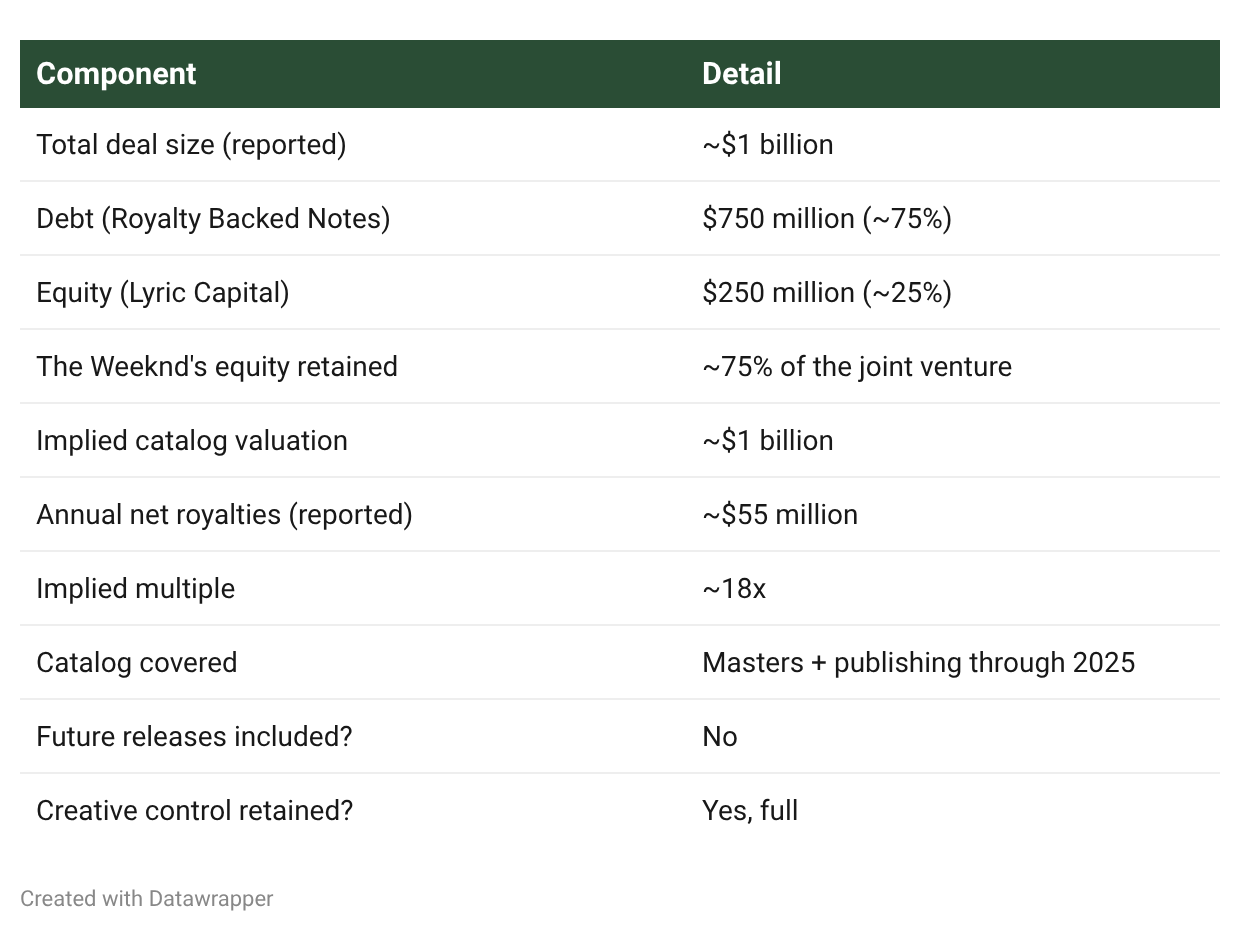
The headline figure ($1 billion) is the total capital raised against the catalog, not the price paid for it. The way it breaks down: $750 million came from debt in the form of Royalty Backed Notes (RBNs) financed by Partners Group. The remaining $250 million is equity, held by Lyric Capital for a 25% stake in the joint venture. The Weeknd holds the other 75%.
Royalty Backed Note: A debt instrument secured against future royalty income. Rather than selling the rights outright, the artist (or rights holder) borrows against the expected cash flows from those rights. The lender gets paid back from royalties over time, plus interest. The artist keeps ownership of the underlying asset.
At ~$55 million in annual net royalties and a $1 billion implied valuation, that’s roughly an 18x multiple – high, but in line with what premium contemporary catalogs have been fetching. The Queen catalog went to Sony in 2024 for a reported $1.27 billion, making this the second-largest single-artist deal publicly acknowledged.
The leverage is the number that stands out most. At 75% debt, this is the most leveraged deal ever done on a single artist’s catalog – by some distance. Most portfolio-level catalog deals use 50-60% debt at most. Doing it at 75% on one artist’s assets is an aggressive bet on the stability and growth of those royalty streams.
Why this makes sense (or doesn’t)
From The Weeknd’s perspective, the logic is straightforward: he monetized the asset without giving it up. He gets $1 billion in capital, which his team can use to fund his production company Manic Phase, future ventures, or whatever he wants, while retaining ownership and creative control. No label approval needed. No new owner telling him what to do with his masters.
That’s a fundamentally different outcome than what Springsteen, Dylan or Spears got. They have more cash, but they no longer own their life’s work. The Weeknd structured his way around that trade-off.
From Partners Group’s perspective, this is about building a new asset class. The Swiss firm launched a dedicated royalties strategy in 2024, targeting $30 billion in AUM by 2033, with entertainment and music royalties making up $6-9 billion of that. Adding The Weeknd – one of the most-streamed artist on the planet – is as close to a flagship investment as you can get. The RBN structure gives them predictable, royalty-backed cash flows from a catalog that is genuinely diversified: it generates revenue across streaming, sync licensing, live performance, and radio, in multiple markets globally.
From Lyric’s perspective, the 25% equity stake is the upside vehicle. If The Weeknd’s catalog appreciates – as premium music assets have done consistently over the last decade – Lyric participates in that gain. They didn’t need to pay $1 billion upfront for 100% ownership to get exposure to that appreciation. They structured their way to it for $250 million.
The part I find most interesting from a wealth management lens is Partners Group’s involvement. This is not a music company, it’s a global private markets firm with $174 billion under management across private equity, infrastructure, real estate, and credit. The fact that they built a royalties strategy and used it to lead the debt financing here tells you something about where institutional capital is heading. Music royalties are being repositioned as “infrastructure-like” assets: stable, predictable cash flows, low correlation to public markets, long duration. That’s exactly the profile that pension funds and family offices are looking for right now.
What to watch
The leverage risk. This is the part most coverage skimmed over. At 75% debt, the deal almost certainly includes financial covenants – conditions The Weeknd must meet throughout the life of the loan. If his catalog underperforms: fewer streams, lower sync income, declining royalties – those covenants could be triggered. In an extreme scenario, the control he structured so carefully to retain could pass to the lenders. That hasn’t happened and may never happen, but it’s the real risk in this deal.
Streaming trajectory. His catalog averaged 17.6 billion global streams per year over the last three years, but 2025 came in below that at 16.5 billion. One year below average isn’t a trend. But the debt is priced against a catalog that needs to maintain its income. If streaming plateaus or declines, which is a real possibility for any artist a decade into their career, the math gets tighter.
Whether other artists copy the structure. The Royalty Backed Note format at this scale is new. If it works cleanly for The Weeknd, if he services the debt comfortably and retains full creative freedom, it becomes a template. This can fundamentally shift the power dynamic between artists and the investment firms that have been buying up music rights for the last five years.
SIDELINE NEWS
Three stories from the last few days that show how much is moving in sports and entertainment right now.
1. Wasserman rebrands to "THE·TEAM" as formal bidding opens
One of the biggest sports and entertainment agencies in the world is up for sale. The Wasserman Group – now rebranded to "THE·TEAM" after parting ways with founder Casey Wasserman over a misconduct investigation – hired Moelis to run the process, with revenues reportedly above $900 million. Their client list runs from Ed Sheeran and Kendrick Lamar to over 4,500 professional athletes. Worth watching: several of the likely PE bidders already hold stakes in sports properties, which creates conflict-of-interest questions.
2. Netflix buys Ben Affleck’s AI startup shortly after walking away from an $83 billion deal
Netflix acquired InterPositive, a 16-person AI filmmaking startup founded by actor Ben Affleck that had been operating in stealth mode since 2022. The timing is intersting: less than a week after walking away from its $83 billion Warner Bros. Discovery bid and getting a $2.8 billion breakup fee, Netflix spent part of it on Affleck's company. Financial terms weren't disclosed. What InterPositive helps filmmakers create their own AI models based on footage they've already shot, then use that model in post-production to reframe shots, adjust lighting, and add visual effects. No synthetic actors, no AI-generated scripts. Affleck joins Netflix as a senior adviser.
3. Apple TV kicks off its F1 contract
The Formula One kicked off its 2026 season in Melbourne last Sunday and George Russell won for Mercedes, leading teammate Kimi Antonelli to a 1-2 finish ahead of the Ferrari pair. For US fans, that race was only available on one place: Apple TV+. Starting this season, Apple holds the exclusive US streaming rights to F1. It’s the first major US sports league to go fully streaming in America.
LAST CALL
$150 million
is the target for Synergy Sports Capital's first fund. The PE firm from former NFL pros Reggie Bush and Terrence Murphy launched recently to buy controlling stakes in emerging leagues. Examples are NWSL (women soccer), Major League Pickleball, TGL Golf, and similar properties. Their valuations are still relatively early and fan bases are growing fast. Murphy and Bush want to get there first, build the operations, and own the upside.
Feedback, thoughts, or suggestions? Leave a comment – I would love to hear from you!